Among St. Louis’s historians and preservationists, the story is well-known. Late in the afternoon of May 27, 1896, the skies above St. Louis darkened dramatically. At around 6:00 p.m., one of the deadliest tornadoes in history touched down just west of Grand Avenue. As it swept eastward towards the river, hundreds of people died and thousands of buildings collapsed or partially collapsed, including the redbrick Soulard market hall. At least five bodies were found in the market hall’s rubble—some say as many as nine.
For three decades thereafter, vendors at the Soulard market were purportedly left to improvise in an empty field, supplied only with a few “temporary buildings,”[1] until the current Soulard market hall opened in 1929. As one historian writes,
“The original Soulard Market building blew down in the Great Cyclone of 1896, the costliest tornado in US history. But even a tornado couldn’t stop the farmer’s market. Rough-and-ready sheds and stalls went up everywhere, and sellers hawked goods from the backs of trucks and wagons. The noisy, bustling market thrived this way for the next 30 years.”[2]
It is a wonderful story of hardscrabble determination in the face of disaster and deprivation. But the larger events surrounding the demise of the old Soulard market hall are considerably more complicated.
True, the Soulard market hall was heavily damaged—nearly destroyed—by the 1896 tornado. However, the front of the market hall—the oldest part—largely survived, and within a year, it had been restored. The redbrick market hall then stood for another three decades, a familiar landmark for the immigrants and other residents who lived in the surrounding tenements and worked in Soulard’s factories and shops. Like much of Soulard, it became increasingly dilapidated, but it never fell into disuse. Well into the 1920s, it was the scene of political gatherings that drew hundreds of people, even as the market trade itself moved outside, under the wagon shed or into the open yard just west of the market hall. Not until 1928 was the old market hall deliberately dismantled to make way for the new market hall that today is a celebrated feature of the Soulard cityscape.

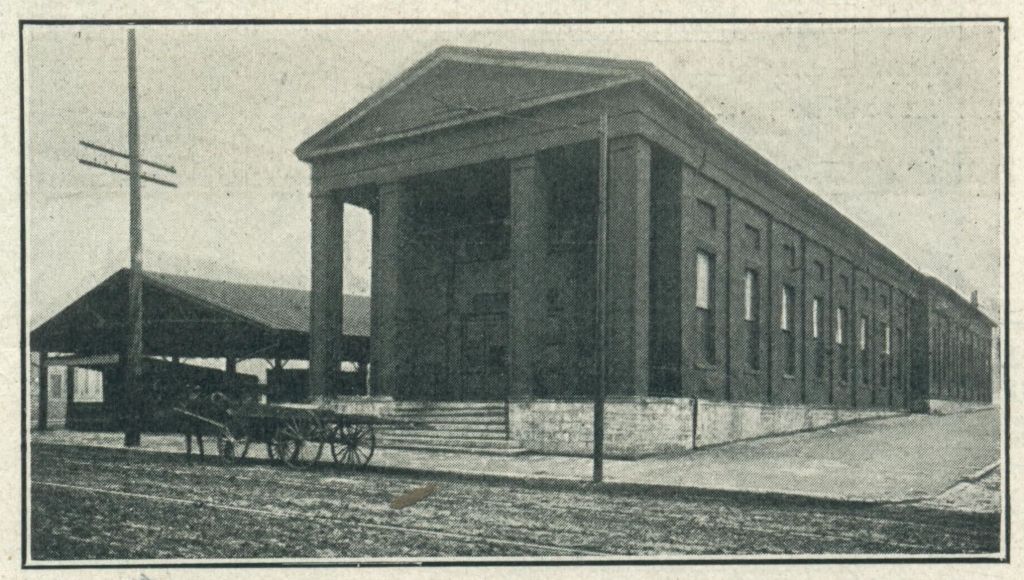
The original Soulard market hall was built in stages, beginning in the 1840s. From the beginning, it was a joint public-private enterprise. In 1843, an ordinance specified that the market building was to “be built under the direction of the City Engineer” and that the City would retain “the right to take possession and control, as city property, the said market house and square.”[3] The ordinance further required that the market hall be built within ten years. This first building faced Seventh Street. Its facade—with steps, a porch, brick columns, and a Roman pediment—signaled its public purpose, and it would survive as a Soulard landmark until 1928.
In 1855, a two-story addition was added to the first building’s rear. That April, several newspaper advertisements solicited in the local papers “sealed proposals for the building of an addition to the Soulard Market House. For the inspection of plans and specifications, apply at the City Engineer’s Office, Town Hall.”[4] Regrettably, the architectural plans for the second building have long since been lost or destroyed. However, we do know that the new building was completed by 1856: on January 8 of that year, the St. Louis Daily Missouri Democrat advertised “a supper . . . at Soulard’s New Market Hall, for the benefit of the Bohemian Church and School” (the St. Louis Leader called the occasion a “festival and tea party”).[5]
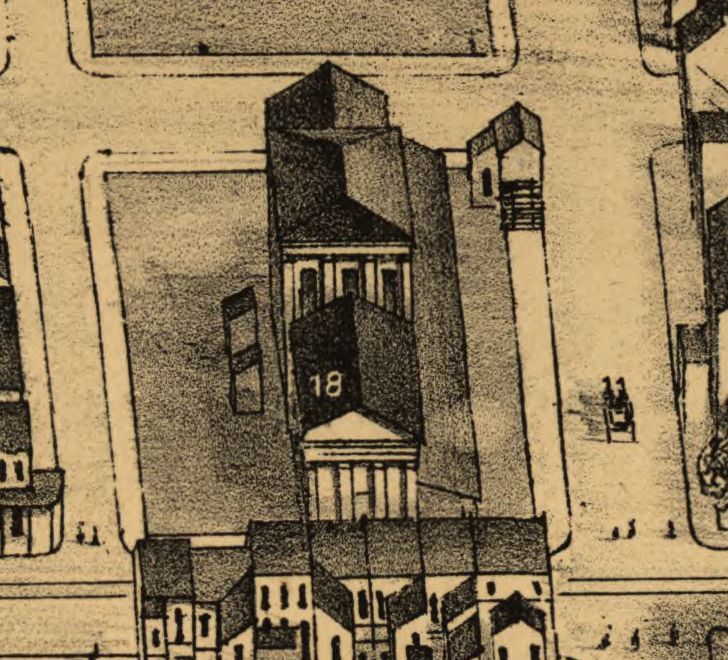
In 1867, the City of St. Louis acquired the Soulard Market for $25,000, paid for by a special bond issue. A third building, added to the rear of the second, was erected sometime after 1868. In December of 1868, the City Council passed “an ordinance for the extension of the Soulard market building from its present western end ninety-eight feet towards Eighth street.”[6] A decade later, Compton and Dry’s Pictorial St. Louis depicted an extended market hall that ran the entire city block—from Seventh Street to Eighth Street. A lean-to covering abutted the north side of the market hall. This was the market hall that Soulard residents would know for some twenty-nine years.
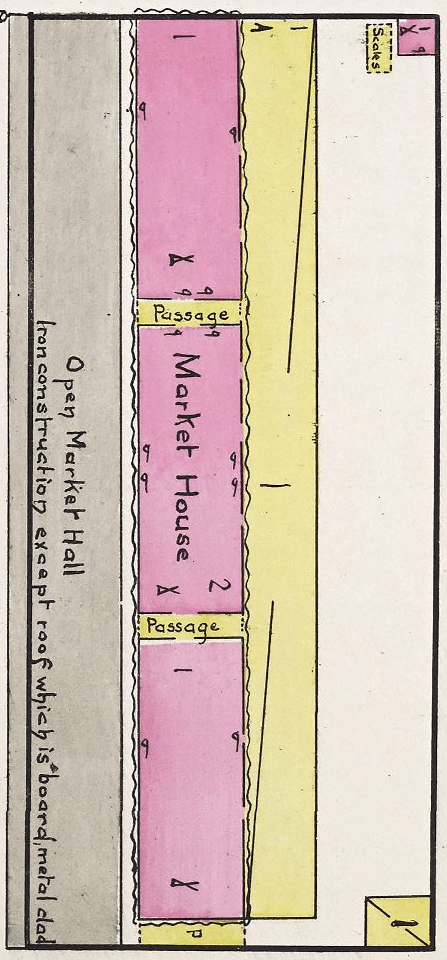
In 1890, a 291-foot-long steel-framed free-standing shed, also called the “open market hall,” was added just south of the brick market hall. Observed one news writer,
“Soulard Market will look like a new building when the improvements now in progress are completed. A new roof is to be put on and the building touched up generally, and an addition in the way of ‘sheds’ is to be built alongside that will cost nearly $10,000. These ‘sheds,’ as they are inappropriately called, will consist of a handsome building with an iron roof resting on iron pillars and being open at the sides.”[7]
When the 1896 tornado struck, the sheds were largely unscathed, protected from the full force of the twister by the brick market hall that was just a few feet to the north. Moving eastward, the tornado nearly leveled the western two thirds of the market hall. The lean-to covering, where several bystanders had taken shelter, was likewise destroyed. However, the eastern third of the building—the oldest part of it—remained largely intact, its four brick pillars in the front somehow withstanding the force of winds that reached speeds in excess of 160 miles per hour.
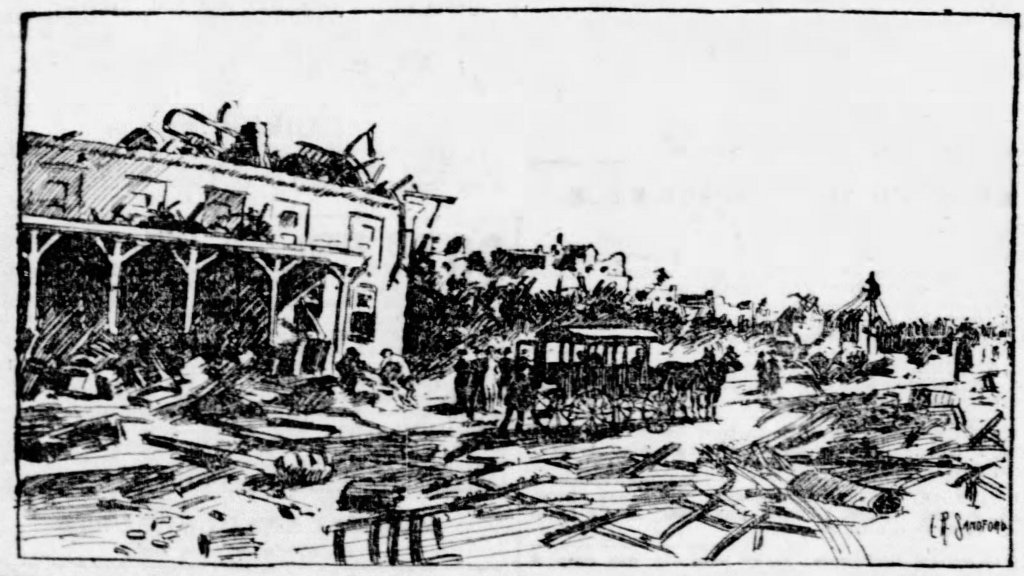
Photographs of the destruction caused by the tornado abound, including two photographs of the collapsed western, or rear, part of the market hall. But no one bothered to photograph the market hall’s front, facing seventh street, probably because it was still standing. Within weeks after the tornado hit, vendors in the western part of the market had relocated to the market’s surviving front. One of the two extant photographs of the collapsed rear of the market hall in fact shows a banner with the words “F. Schrader removed to east end of market.” Declared one widely published contemporaneous account, “tradesmen whose shops are demolished have contrived temporary quarters under the sheds and in that portion of the old building still standing.”[8]

Meanwhile, in the summer of 1896, as south St. Louis recovered from the disaster, residents in Soulard advocated for the market hall’s resuscitation. On August 24, a “delegation of South Side citizens called on [the city Comptroller] to plead for the rebuilding of Soulard Market.”[9] On September 19, several city officials determined to “work toward cleaning up the wreck of the Soulard Market and making the building tenable. They paid a visit to the spot and after a careful inspection, decided to have the work-house gang clear away the debris at the west end and partially restore the building.”[10] On December 23, 1896, the St. Louis Board of Aldermen passed ordinance no. 18,725. Its wording speaks to a building that was ravaged yet redeemable, with the estimated cost of repair coming to $5000. (It proved to be an overestimate; the winning bid for the repairs was $3900.) The ordinance authorized the Board of Public Improvements to reduce the size of the building by a third, thereby restoring it to the size it had been prior to 1869. “The site of the western [the rear and newest] building [was] to be leveled off and paved with brick, the eastern [the oldest and front] building to be repaired, the central building to be rebuilt.” A granitoid floor was to be added to the eastern building.[11]
Rebuilding and repairs went quickly. Less than a year after the tornado, the market hall was up and running again. It now consisted of not three but “two buildings, each 32 by 60 feet, placed end to end and separated by a brick-paved passage which permits traffic to cross the lot to the wagon shed south of the buildings. Both buildings are of brick with metal roofs. The one facing seventh street, which is the main entrance, contains a middle passage with stalls on each side, the division between which is indicating by a number of wooden box posts extending from the floor to the ceiling.”[12] The rebuilt building behind it –which before had been the middle building–was now only one story, and the roof of both buildings was the same height.
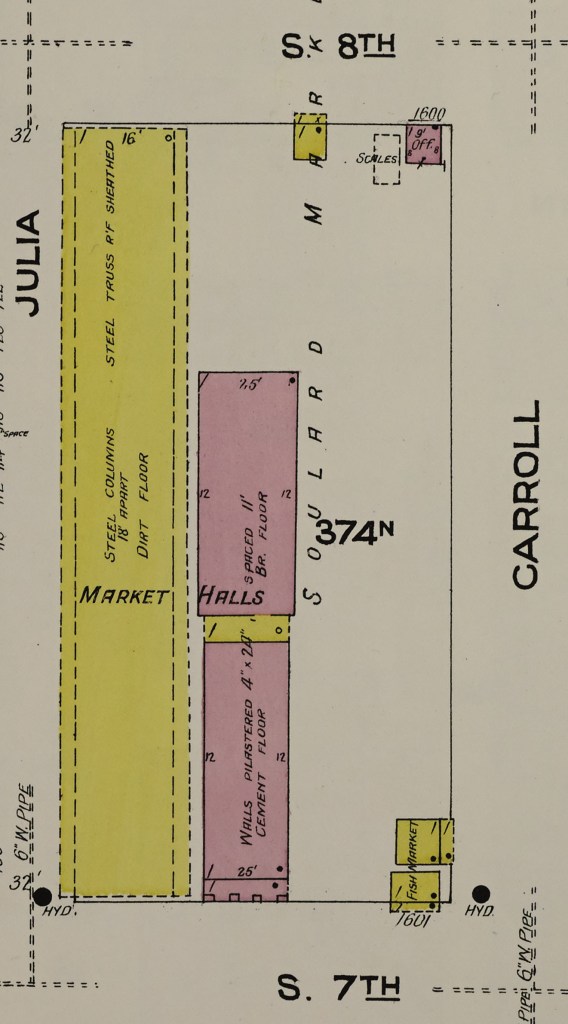
Ten years later, in May 1907, $550 was spent on “repairing brick work, tuckpointing, and staining Old Market House; new sash cords for windows; repairing wooden ceiling; painting inside walls and ceiling; new galvanized downspout for south side, and new locks for office and closet doors.”[13] The investment indicates that civic authorities regarded the rebuilt structure as something a good deal more than temporary. As one historical-minded civic booster wrote, “Soulard Market is to-day the same as it was many years back: the same as regards the haggling over viands and the gesticulating which invariably accompanies the business transactions of the Teuton. The market-hall shows distinctive signs of age, but despite the mutations wrought by time, its clumsy architecture is with us still.”[14]
Even so, the market hall’s long-term viability was threatened by vendors’ preference for the cheaper spaces outdoors and by an increasing number of grocery stores in the neighborhood. In 1902 and 1903, municipal officials proposed using the hall as a public bathhouse, but nothing came of it, because contractors never submitted an acceptable bid; the bathhouse instead opened in 1909 on the other side of Seventh Street, across from the market hall. In 1910, one national periodical lamented the dismal state of the market hall, foreshadowing the criticism of the aging structure that would eventually lead to its replacement. “It is the least sanitary of the city markets and the least remunerative. But four stalls are now rented, and these do not have an attractive appearance.”[15]
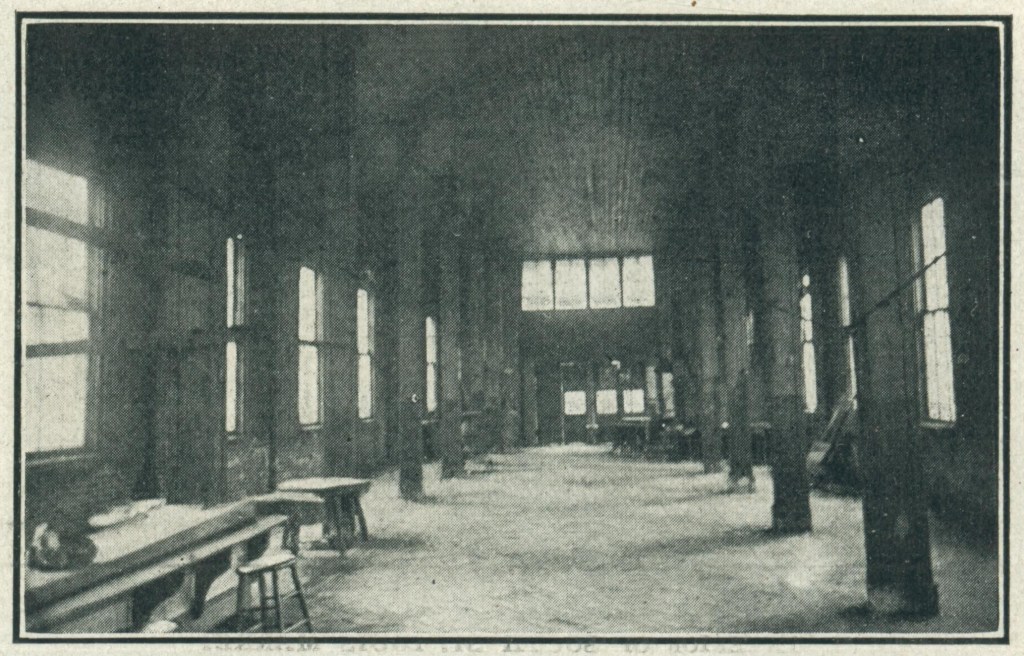
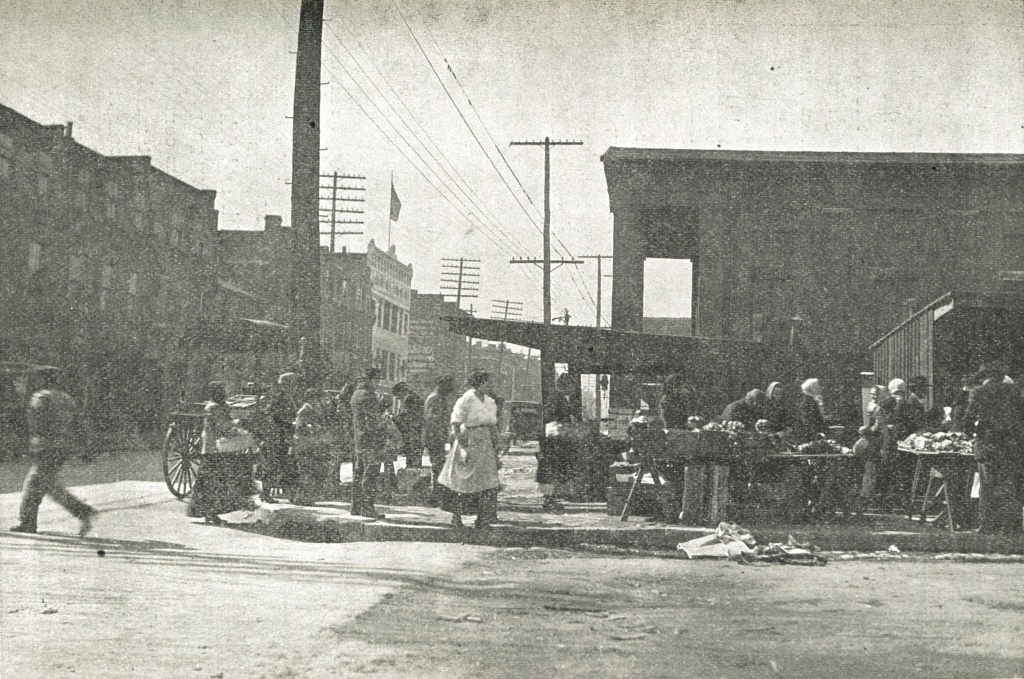
I have found nine photographs of the market hall (or parts of it) that were taken between 1897, when the market was rebuilt, and 1928, when it was torn down. Two date from 1910. One of these photographs depicts the original market hall building’s interior, photographed looking east, towards the entrance. Though the emptiness is apparent, the windows and inflowing light are impressive. An accompanying photograph (reproduced at the top of this blog post) depicts the facade and north wall of the market hall, with a horse and wagon parked on the macadam street out front.
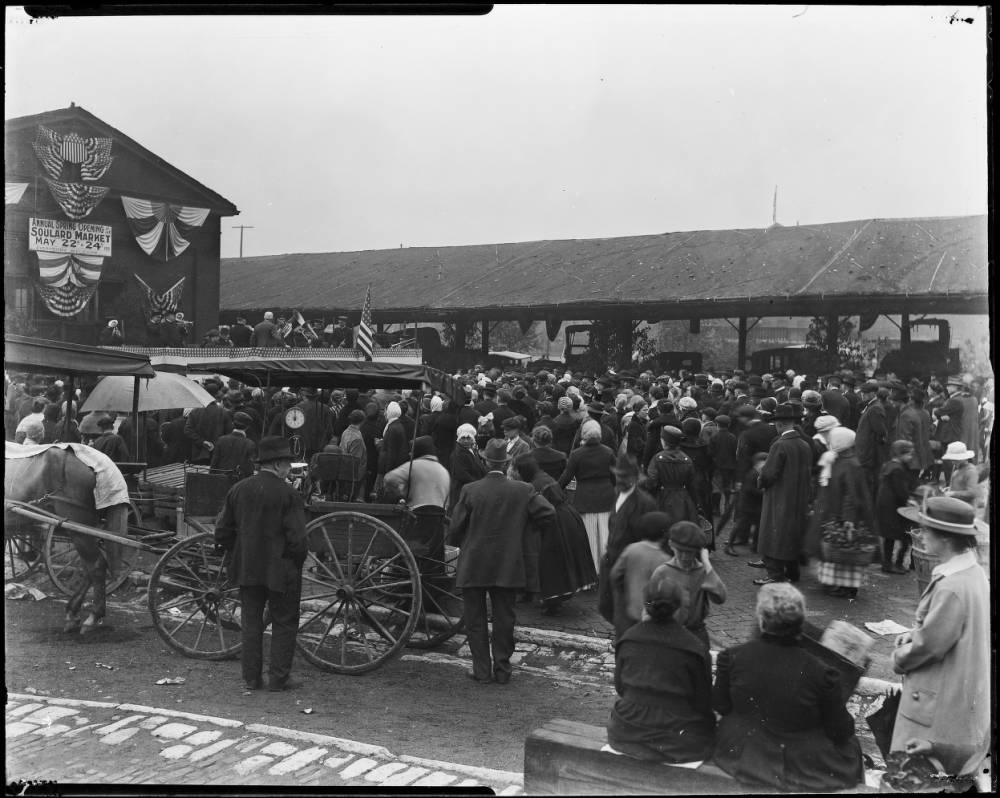
Two photographs by Richard W. Lemen, both made in May of 1919, document the outdoor festivities that accompanied the reopening of the market following the Great War and the influenza pandemic. The first photograph shows but a glimpse of the market hall’s western gable. The second, badly faded, shows the market hall’s rear building, decorated with bunting and a flag. It appears massive above the pedestrians below.

Another photograph, published in 1923, depicts the market hall’s antebellum front. Once again, the size of the market hall relative to the bystanders is impressive. It is a reminder that the redbrick hall was a fixture for tens of thousands of people who visited the market between 1897 and 1928.
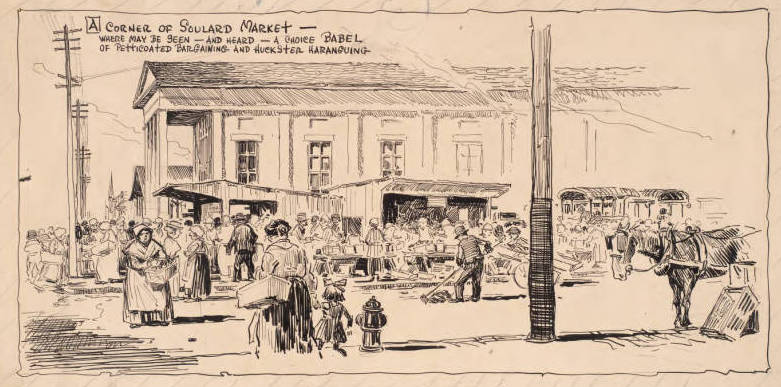
Perhaps the best representation of the old Soulard market hall is a World War I-era ink drawing by Archibald B. Chapin, published in the St. Louis Republic. In the foreground, the fishmonger’s stand figures prominently; the market shed peeks out from behind the market hall. The spire of Ss. Peter and Paul Church is visible in the background.
But the market hall’s days were numbered, largely due to a growing recognition that it was obsolete. Progressive thought and activism in the early 1900s emphasized sanitation and cleanliness. In the 1920s, a love of modernity reinvigorated these values. As the oldest of St. Louis’s four public markets, Soulard Market would not evade censure. In February 1923, the Consumers League of St. Louis took out a full-page ad in the Post-Dispatch calling for support of a bond issue to redevelop St. Louis’s markets. “Sanitary markets mean clean foods,” averred the advertisement. “Our present public markets are worn out and out of date. . . . Think of it! All old buildings where sanitation and drainage is [sic] very poor. Are we asleep? Let’s build new sanitary markets.”[16] The campaign succeeded. Later that year, the Board of Aldermen approved a $1,125,000 bond issue to fund the rebuilding of St. Louis’s markets. In 1927, $170,000 of the money was appropriated for rebuilding Soulard market; an additional $97,000 was drawn from a bond issue for parks and playgrounds.
To make way for the new market hall, the old Soulard market was dismantled. How the razing was carried out—whether by bulldozer, wrecking ball, or sledgehammer—is lost to history. The exact date of the market’s demise is also unknown. In the local press, there was not so much as an announcement, only a passing observation, in May of 1929, that the original “building was wrecked last year to make way for the new architecture.”[17]
Today, it is hard to imagine a preservation-oriented community standing for the market hall’s demolition. After all, the front building of the market hall, which by 1928 was nearly eighty years old, had seen more than its share of history. In 1852, newspapers across the country had reported that German immigrants had fired upon nativists casting ballots at the market; “the Soulard Market House was entirely riddled.”[18] By 1855, it had housed a mission Sunday School that distributed “tracts and other missionary propaganda,” sometimes aimed at converting the neighborhood’s Jews.[19] In 1861, it had been the command center for a regiment of Home Guards stationed on the market grounds. 1862, it had been the Second Ward’s headquarters for enrollment in the Union Army. In 1865, the market hall had become the command center for Union troops billeted on the market grounds. In 1877, to serve Soulard’s poor, the Soulard Market Mission had moved into the market hall and had remained there until the 1896 tornado struck. “For a long time attendance at Sabbath-school averaged from 800 to 900, and frequently more than 1300 were present.”[20] Even after the tornado and nearly until the moment of its demise, the market hall was the scene of political gatherings. In early March of 1921, for example, Grace Semple, chair of the Republican Women’s Club of St. Louis, addressed some 350 Republicans in the hall; later that month, Mayor Kiel addressed a crowd of a thousand.
And so the question remains: why has the restored market building—the one that stood between 1897 and 1928—been largely omitted in contemporary accounts of Soulard, especially when so many photographs and drawings testify to its existence? And why have historians and civic authorities repeatedly asserted that the original market hall was destroyed by the tornado in 1896 instead of by the builders of the new market hall? Is the oversight only accidental, or might it represent a more significant lapse in St. Louis’s collective memory?
Part of the answer may lie in the fact that the opening of the new market hall was a bright spot in an otherwise dim period in the history of the surrounding neighborhood. Throughout the 1920s, the neighborhood steadily lost residents to newer housing developments south of Arsenal Street, including such neighborhoods as Bevo Mill and Princeton Heights. Then, in the 1950s, the building of the Third Street Interregional Highway (later Interstate 55) and the razing of most of the historic buildings east of Seventh Street, including the Soulard Bath House, resulted in the destruction of a considerable part of the neighborhood. The market itself was now hemmed in by the highway to the west and the Seventh Street artery to the South. By the late 1960s, the neighborhood would be termed by at least two sociologists as a “white slum.”[21]
As the Soulard neighborhood’s decline gave way to decay, the new Soulard Market Hall stood out because of its beauty and vibrance. Early efforts by preservationists understandably centered on the new market’s vitality. The successful application to list the Soulard Market on the National register of Historical Places, which was submitted in 1972, celebrated the new market building while obscuring the fate of the old one:
“The Soulard Market is the most significant business in the neighborhood. An earlier Soulard Market building was destroyed in the tornado of May, 1896, and for several years thereafter the market operated in a variety of temporary quarters at the present location between Seventh, Ninth, Carroll, and Lafayette avenues. The current Soulard Market building was constructed by the City of St. Louis in 1928-29 and is a large structure of Italianate design. The central portion contains a gymnasium and a community center, and market activities are conducted primarily in the long flanking wings.”[22]
Early preservationists’ celebration of the new Soulard market building was aided by the fact that it had an antique appearance. The architecture of its south entrance echoed the Florentine foundling hospital designed by Filippo Brunelleschi in the early 1400s. Perhaps it was easier to forget the erasure of the old market hall when its replacement also evoked a sense of history. In any case, the new market hall was (and is) one of the jewels of Soulard. And why dim the luster of a civic jewel by pointing out that its existence was predicated on the destruction of another?
Furthermore, contemporary historians and preservationists may simply find it too painful to recognize that the old market hall was dismantled deliberately. Granted, more beautiful buildings in St. Louis have been deliberately destroyed, and with far less reason. And the new market hall has been a success story on many levels, helping to stabilize the surrounding neighborhood by drawing attention to its history and character. But when the old market hall was dismantled in 1928, an important connection to the past was severed. For all eight decades of its existence, it was a place where commerce, politics, and religion intersected visibly and sometimes violently. In light of its history, we are poorer without it, and its absence should serve as a reminder that much of what we choose to preserve or otherwise celebrate often stands upon the grave of something that came before.
Notes
[1] U.S. Department of the Interior, “National Register of Historic Places Inventory—Nomination Form,” Soulard Neighborhood Historic District, submitted by Stephen J. Raiche, June 20, 1972.
[2] History Happens Here (blog of the Missouri Historical Society), “Soulard Market’s Unlikely Survival Story,” by Andrew Wanko, posted May 9, 2019.
[3] Ordinance No. 1300, approved November 15, 1843, The Revised Ordinances of the City of Saint Louis (St. Louis: Chamber & Knapp, 1850), 276.
[4] Advertisement, Daily Missouri Democrat, April 25, 1855.
[5] Advertisement, Daily Missouri Democrat, January 8, 1856; advertisement, The Leader, January 5, 1856.
[6] “City Council Proceedings,” Missouri Daily Republican, December 19, 1868.
[7] “New Soulard Market,” St. Louis Post-Dispatch, October 10, 1890.
[8] “Estimates of the Losses Inflicted upon the City of St. Louis by the Cyclone,” Los Angeles Herald, May 31, 1896.
[9] “Municipal Matters,” St. Louis Daily Globe-Democrat, August 25, 1896.
[10] “To Restore Soulard Market,” St. Louis Post-Dispatch, September 19, 1896.
[11] Ordinance No. 18,725, approved December 23, 1896. I am grateful to Stuart Baker for retrieving a copy of this ordinance from the archives of the City of St. Louis.
[12] Charles Claude Casey, “Municipal Markets of St. Louis,” Municipal Journal and Engineer 28, no. 17 (April 1910): 614.
[13] “Journal of the Board of Public Improvements,” St. Louis Daily Globe-Democrat, May 11, 1907.
[14] Philip Skrainka, St. Louis: its History and Ideals (St. Louis: [Lambert-Deacon-Hull printing co.,] 1910), 68.
[15] Casey, “Municipal Markets of St. Louis,” 614.
[16] Advertisement, St. Louis Post-Dispatch, February 4, 1923.
[17] “New Soulard Market, Which Cost 267,000, to Open Thursday,” St. Louis Daily Globe-Democrat, May 5, 1929.
[18] “St. Louis Riots!,” The Weekly Pentagraph (Bloomington, IL), April 21, 1852.
[19] Karl M. Vetsberg, “Reminiscences of a Former St. Louisan,” The Jewish Voice, November 6, 1914.
[20] “Presbyterianism in St. Louis, Missouri,” The Herald and Presbyter 78:11 (March, 1907): 10.
[21] William L Yancey and Lee Rainwater, “Problems of Ethnography in the Urban Underclass,” in Pathways to Data: Field Methods for Studying Ongoing Social Organizations, ed. Robert W. Habenstein, (Chicago: Aldine, 1970) 245–69.
[22] U.S. Department of the Interior, “National Register of Historic Places Inventory—Nomination Form.”
 Immigrant Identities in St. Louis, 1903-1935