
In 1909, the City of St. Louis razed two blocks of buildings in Soulard to make way for Soulard Place, also known as the Soulard Park and Soulard Playground. Located immediately south of the Soulard Market, near Soulard’s most densely populated blocks, the new 1.9-acre park provided much-needed recreation for working-class residents. Among the most important visitors were immigrants, many of whom hailed from rural regions in southeastern Europe and presumably missed the open air. The park would become part of the built environment—along with the nearby library. bathhouse, and police station—that would help instill in immigrants an American civic consciousness.
Opened in the fall of 1910, the park was an immediate success. In just two years, it was used by 152,469 children. They played on swing sets and teeter totters, competed in baseball and net handball tournaments, and (after 1918) soaked their feet in the park’s wading pool. At night, under the electric arc lights, they could attend neighborhood dances, film screenings, and band concerts.
But like later acts of urban renewal, the establishment of the park came at a cost. As I write in The Names of John Gergen,
“Some fifty-seven buildings were razed, among them tenements, stores, a saloon, and two restaurants. Dozens of residents were displaced, as were a butcher, a tailor, a physician, a dressmaker, a poultry vendor, two fruit vendors, a dry-goods dealer, a barber, and a female grocer. Typical was the case of the Prelutskys, a Jewish family of eight who migrated from Russia in 1897 and lived in a building at the corner of Ninth and Julia Streets, where they sold notions and candy. Evicted from their shop-cum-residence, they moved to an apartment above a saloon at 1712 South Broadway, where the traffic was heavier, the air pollution thicker, and the noises louder. Without their store, they became wage earners” (The Names of John Gergen, 51).
Fortunately, in February of 1909, the St. Louis Parks Department thought to photograph the buildings that stood condemned. Two of these photographs survive, having been published in the department’s annual report. One shows a row of houses that had been subdivided into apartments: Soulard’s tenements, many inhabited by recent immigrants. The other shows Louis Prelutsky’s vacated store, still draped with a banner advertising the final clearance sale. In both photographs, the ruts in the macadam streets are clearly visible.
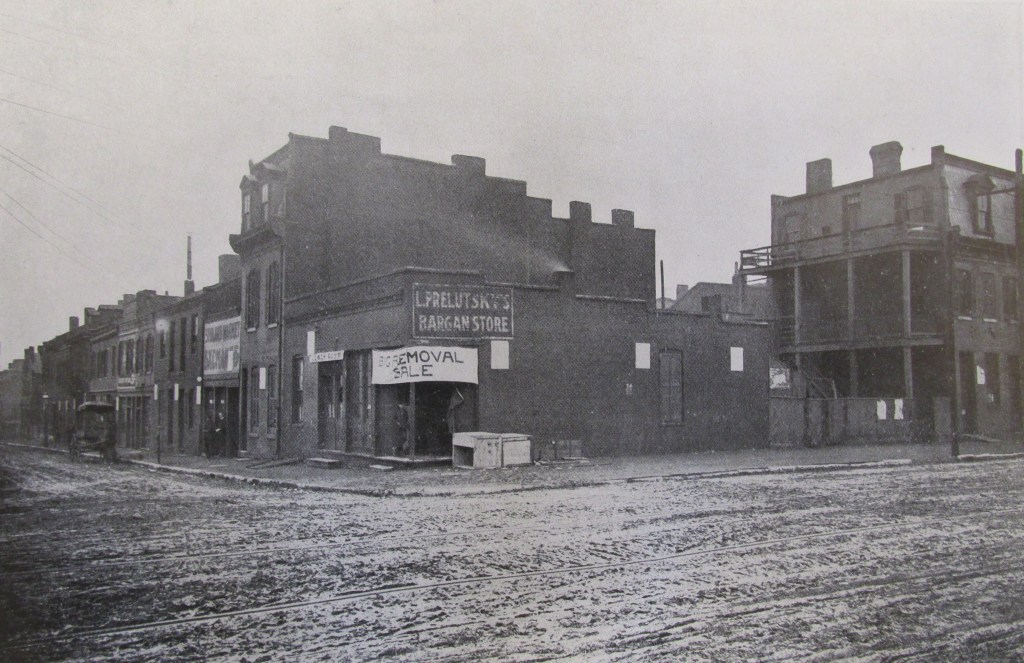
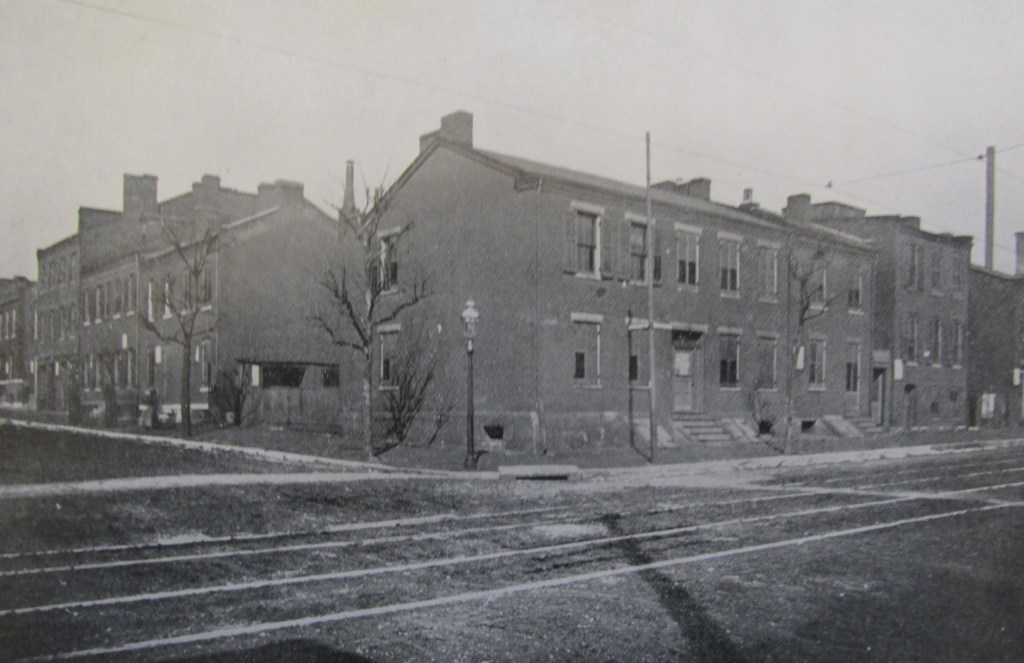
The buildings that were razed, together with the land beneath them, cost the city $170,680 –about $5,292,400 in 2020 dollars. The cost to the people who lived and worked there is unknown.

 Immigrant Identities in St. Louis, 1903-1935